

Market Intelligence Analyst
The insight machine—these analysts interpret trends, competitors, and customer behavior to sharpen strategy and gain a competitive edge. They see what’s coming before anyone else. They are the future thinkers.
What is a Market Intelligence Analyst?
The insight artist your brand didn’t know it needed
Creative ideas don’t exist in a vacuum. They live and breathe inside culture—alongside shifting audience expectations, evolving technologies, and competitors trying to outmaneuver you at every turn. That’s where a Market Intelligence Analyst steps in.
They’re not number crunchers. They’re cultural cartographers. Insight hunters. Strategic translators.
Market Intelligence Analysts are the ones who turn market chaos into clarity—filtering out the noise, tracking emerging trends, decoding consumer behavior, and helping brands understand what’s next before it happens.

The Insight Machine
What do they actually do?
At their core, Market Intelligence Analysts gather, organize, and interpret data that helps companies make smarter, faster decisions. But it’s not about dumping spreadsheets on your desk—it’s about storytelling with substance.
They:
- Spot patterns in consumer behavior before they go mainstream
- Analyze competitors’ positioning, pricing, creative, and messaging
- Monitor cultural shifts across regions, generations, and industries
- Recommend where brands should invest, innovate, or pivot
Think of them as creative enablers—arming strategy, brand, and creative teams with insights that sharpen ideas and keep the work relevant.
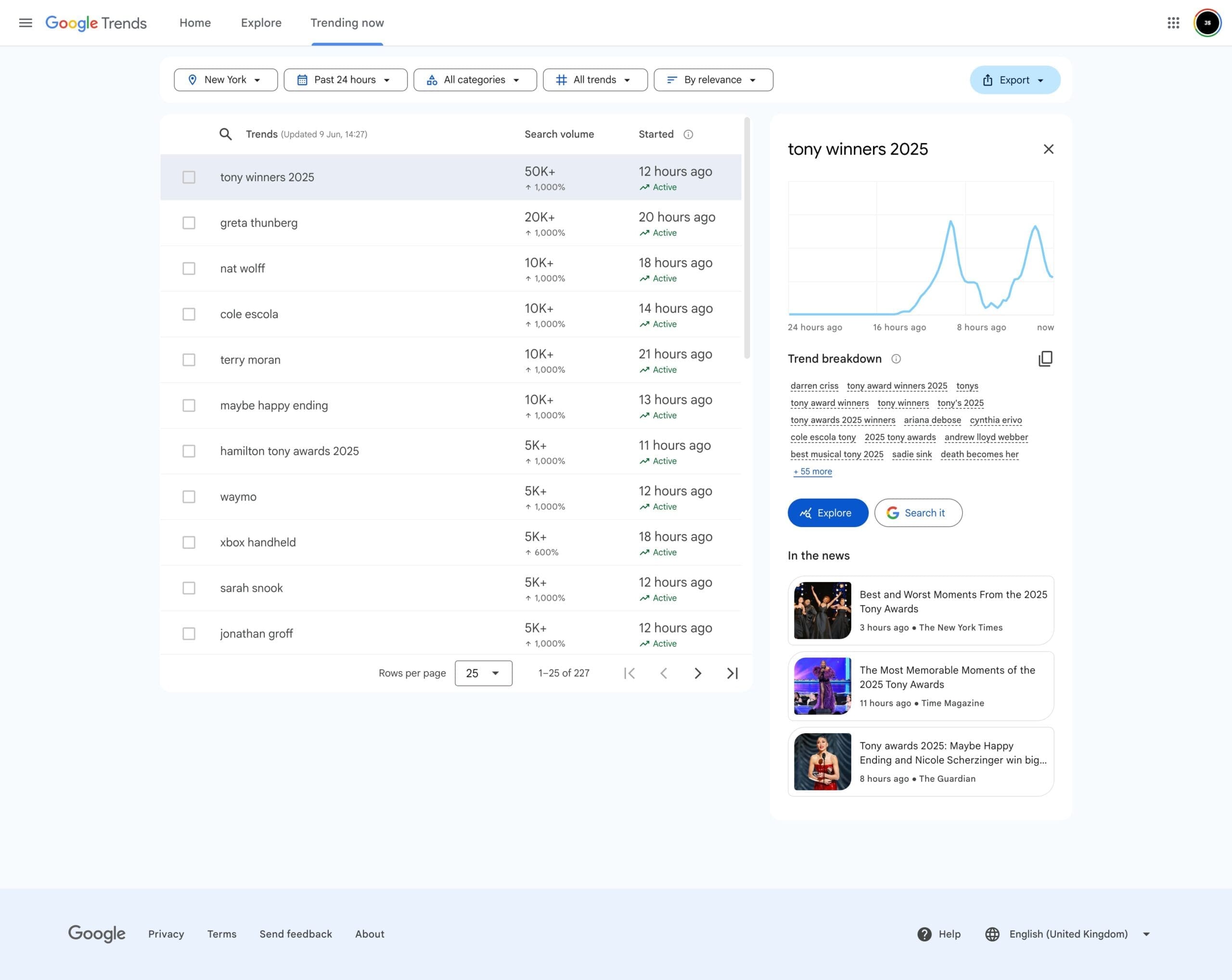
Tools like Google Trends help Market Intelligence Analysts track what the world is searching for—revealing consumer intent, emerging narratives, and real-time opportunities.
What’s in their toolkit?
You can’t see the future without the right lenses. And Market Intelligence Analysts are loaded up with tools that help them zoom in, zoom out, and dig deep.
Here’s what’s in their arsenal:
- Quantitative research tools
GWI, Nielsen, Mintel, Statista—sources for consumer data and global trend tracking. - Social listening platforms
Brandwatch, Sprinklr, Talkwalker—scanning millions of conversations to catch early cultural signals. - Competitive intelligence platforms
Similarweb, Crayon, SEMrush—dissecting competitor strategy across web, ad, and content activity. - Surveys & panels
Attest, Qualtrics, SurveyMonkey—gathering custom insights directly from target audiences. - Insight storytelling tools
Tableau, Figma, Notion—bringing data to life visually for non-technical teams.
But their most important tools? Intuition, curiosity, and a bullshit detector that’s always switched on.
Why it matters for creative agencies
At RIOT, we believe great creative isn’t just loud—it’s smart. That means knowing when to rebel and when to redirect. Market Intelligence Analysts help us do just that.
They don’t kill creativity—they unlock it. By grounding ideas in cultural and commercial truths, they help creative teams:
- Pitch with confidence
- Back bold ideas with hard data
- Stay ahead of trends—not chase them
When insight meets imagination, work lands with more relevance, resonance, and power.
A day in the life—insight in action
Let’s say a fashion client is expanding into Latin America. The creative brief? “Be bold, local, and Gen Z-friendly.”
A Market Intelligence Analyst:
- Maps out the TikTok subcultures gaining momentum in Brazil and Argentina
- Identifies gaps in competitor messaging—where no one’s owning sustainability and style
- Flags youth-led movements with emotional pull
- Feeds the strategy and creative team a cultural mood board with proof points
The result? Creative that’s not just fresh—it’s frictionless, on-brand, and untouchable.
What makes a great Market Intelligence Analyst?
They’re part strategist, part researcher, part storyteller. The best ones combine business savvy with cultural sensitivity and can shift gears from data viz to brainstorm in seconds.
Key traits:
- Pattern recognition ninja
- Strategic empathy
- Strong communication—turning data into story
- Tech fluency, with a pulse on culture
They don’t just work behind the scenes—they fuel the scenes.
RIOT’s POV
We don’t do guesswork. We do brave work—backed by insight, powered by instinct. At RIOT, Market Intelligence isn’t a separate function—it’s embedded in the way we think, create, and collaborate.
Because rebellion without direction is noise.
And creativity without context is chaos.
Want to make something bold and brilliant?
Get yourself a Market Intelligence Analyst—and let’s turn insight into impact.
Related Glossary Terms
Brand Strategist, Audience Insights, Trend Forecasting, Competitive Intelligence, Cultural Strategy
Related Job Roles
Brand Strategist, Cultural Strategist, Data Analyst, Insights Manager, Consumer Researcher, Strategy Director