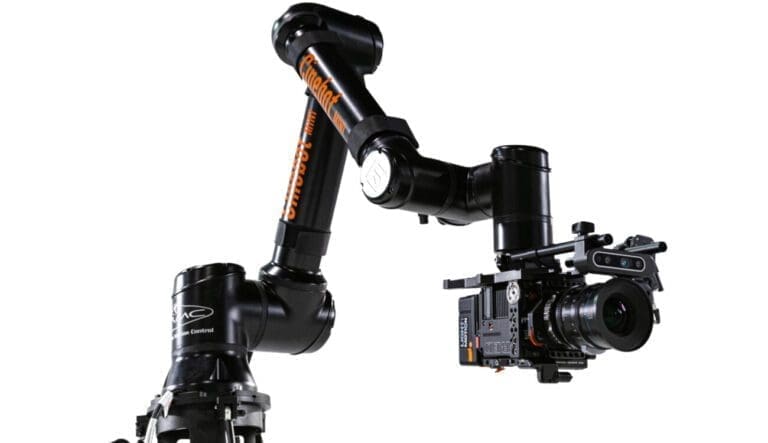
What is cinematic motion control?
Motion control, often shortened to moco, is a camera rig whose every movement is stored as data. The path is designed on a screen, loaded onto the rig, and executed by motors, so the camera begins and ends at the same point, at the same speed, through the same curve, every time it runs. The rig can be a programmable slider, a motorized head on a crane, or a full industrial robot arm carrying a cinema camera at high speed.
Motion control began in visual effects, where it was the only way to shoot a spaceship model and a star field on separate passes and line them up. Commercial production adopted it because product work needs the same thing: multiple passes that match, and a smoothness of movement no hand can deliver at macro scale.
Why it matters
Why cinematic motion control matters
It changes what a shot can be. A move that passes through a ring, around a bottle and up to a face at speed is not achievable by an operator; a robot does it in two seconds and does it again. A layered shot, with the product on one pass and the liquid on another, needs the passes to match or the composite falls apart. Motion control is the only reliable way to get them to match.
It also brings a rare kind of calm to a set. Once the move is programmed, the director is no longer hoping for the take. The conversation moves to light, styling and timing, which is where creative attention is best spent.
In practice
How cinematic motion control works in practice
- 01
Preparation is the work. The move is designed in previsualization software, often with a 3D model of the set and the product, so that the lens, the speed and the framing are agreed before the day. The rig technician checks reach, clearances and safety, because an industrial arm at speed does not stop for anyone.
- 02
On set the first hour is rehearsal at reduced speed with stand-in objects, then full-speed passes to refine. Lighting is built for the exact path the camera takes. Then the shoot becomes a loop: reset the product, run the move, review, repeat. Each pass is logged with its program so post can match plates without guesswork.
Watch out
What people get wrong about cinematic motion control
Booking the robot without booking the prep. Motion control is a planning discipline that happens to involve a machine; a crew that arrives with a vague shot list will spend the morning designing moves on a very expensive clock. The other mistake is using it for everything. A handheld interview and a slow dolly on a face do not benefit from a robot, and a day rate spent there is a day rate wasted.
The third is forgetting the lens and the lighting. A fast move magnifies every flicker in a light source and every breathing in a lens, so the camera package has to be chosen for the rig, not just for the look.