Creative agency glossaryVideo and Post-Production

Robotic Camera Arm

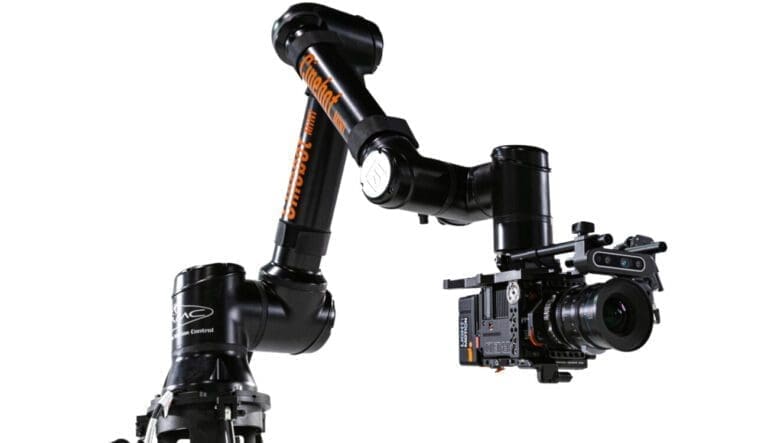
A robotic camera arm is an industrial multi-axis robot adapted to carry a cinema camera, moving it through programmed paths with speed and precision no human operator can match.

What is a robotic camera arm?

A robotic camera arm is the same kind of machine that builds cars, repurposed for pictures. A six-axis industrial robot is mounted on a base or a track, fitted with a camera head and controlled by software written for film, and the result is a camera that can reach, spin, whip and stop in ways no crane or dolly can. The arms range from compact models built for tabletop work to full-size units that fly a heavy cinema camera across a stage at several meters per second.

The arm is one part of a system. It needs its base, its track if it travels, a controller, software that turns a creative move into motor instructions, and a technician who programs, runs and makes it safe. Rental houses supply the whole package, because almost nobody owns one.

Why it matters

Why a robotic camera arm matters

The arm makes a category of shot possible. A camera that passes through a ring, orbits a bottle at speed and settles on a face in a single move is an arm shot. A high-speed pass through a splash, triggered on the same frame every time, is an arm shot. A layered composite with three elements captured on three identical passes is an arm shot. Those images have defined high-end product advertising for a decade, and the arm is why.

It also replaces time with planning. A sequence that would take a crew a day of attempts can be captured in a few passes once the move is built, which is why arm shoots are front-loaded into prep and short on the day.

In practice

How a robotic camera arm works in practice

  1. 01

    Everything begins in software. The move is designed against a model of the set, the product and the lens, with the technician checking reach, speed and clearances. On the day the arm is positioned, calibrated and run slowly with stand-in objects while the director and the cinematographer refine the framing. Safety is strict: a working radius is marked and barriered, and nobody enters it while the arm is live.

  2. 02

    Then the passes. The arm runs the move at full speed, the crew resets the product or the effect between runs, and each pass is logged with its program. Lighting is built for the camera's path, and effects are triggered from the same timeline so that the event and the camera meet on the frame. The data goes to post along with the footage.

Watch out

What people get wrong about robotic camera arms

Treating the arm as a camera support. It is an industrial machine first, with weight, power and safety requirements that a normal shoot day does not plan for, and productions that discover that on the morning lose the morning. The other mistake is over-reaching. The biggest arm is not the right arm for most product shots; a compact system often delivers the move with less space, less setup and less cost, and the budget is better spent on the light and the set.

Questions

People also ask

How fast can a robotic camera arm move?

Full-size cinema robots can move a camera at several meters per second and stop within a fraction of a millimeter of the programmed point. Compact arms are slower but still far beyond what an operator can repeat by hand.

Is a robotic camera arm safe to use with people on set?

With the right protocol, yes. The working radius is cleared and barriered, moves are rehearsed slowly before running at speed, and the technician has an emergency stop. Talent is placed outside the envelope or the move is designed around them at reduced speed.

What does a robotic camera arm cost to use?

The rental, the technician, a prep day and transport are the main costs, and they vary with the size of the arm. Against that, the shoot day is usually shorter and the compositing simpler, so for layered or high-speed product work the total is often competitive with a conventional shoot.

Next to it in the glossary

  1. Production Studio RentalProduction studio rental is hiring a purpose-built space for a photo or film shoot, with controlled light, power, height and quiet that a location cannot promise.
  2. Programmable Camera MovementsProgrammable camera movements are camera moves defined in software and executed by a motorized rig, so the same path, speed and timing can be played back on every take.
  3. RenderingRendering is the process by which a computer turns an edit, an animation or a 3D scene into finished frames that can be played back or delivered.
  4. Robotic FilmmakingRobotic filmmaking is the use of programmable robots, from camera arms to motorized lights and automated product handlers, to execute shots that are planned in software and performed by machines.
  5. Set DesignSet design is the creation of the physical environment a scene is filmed or photographed in, from a single styled surface to a fully built room, so the space tells the story the brand needs.
  6. Smart Device Camera ControlSmart device camera control is the operation of cameras, motorized rigs and lighting from a phone or a tablet, letting a crew program moves, trigger shots and adjust settings without touching the equipment.

Every Video and Post-Production term →

In the work

Where it shows up

All our creations →

From the journal

Read around it

The journal →

Talking the talk is one thing

We make the work.

RIOT is a creative agency and production studio in New York. Strategy, brand, film, photography, design and the campaigns that carry them, made by one team. A few lines is enough to start: we read every brief the same day.

    Footage