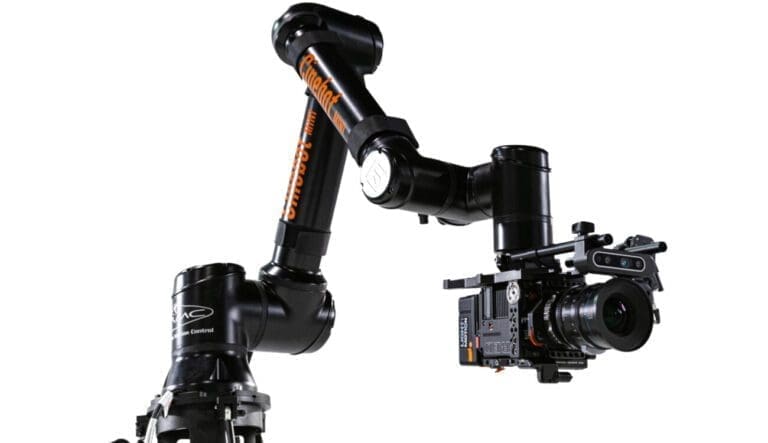
What is a motion control rig?
A motion control rig is the physical machine behind repeatable camera movement. At its simplest it is a slider or a pan-and-tilt head with motors and a memory; at its most capable it is a multi-axis robotic arm on a track that can carry a cinema camera through a complex path at high speed. In between sit motorized cranes, cable systems and compact tabletop robots built for product work. What makes any of them a motion control rig is the same thing: the move is programmed rather than performed, and the rig can run it again and again without variation.
Each rig is a package. The mechanical arm or track, the motors and encoders that know where the camera is, the controller and software that define the path, and the technician who builds and runs the move. Remove any one of those and the rig is just a heavy stand.
Why it matters
Why a motion control rig matters
The rig is what turns a camera move from a hope into a fact. An operator can push a dolly beautifully but never identically; a rig does it identically every time, which is what layered shots, matched passes and precise macro work require. It also makes speed safe. A camera flying past a product at several meters per second is only practical when the path is fixed and the stop is guaranteed.
Choosing the right rig is a creative and financial decision. A small programmable head costs a fraction of a robot arm and covers most slow product moves; the arm is for the shots that genuinely need reach, speed and heavy payloads. Matching the rig to the shot is where a good producer saves a budget.
In practice
How a motion control rig works in practice
- 01
The move is designed in software, often against a 3D model of the set, and loaded onto the rig's controller. The technician sets the rig's position relative to the set, defines the limits of travel for safety, and runs the move slowly to check framing, focus and clearances. Lighting is built around the path, since the camera will be in the same place on every pass.
- 02
Once the move is approved, the rig runs it at full speed for each take while the crew resets the product, the effect or the lighting state between passes. The controller logs each run so that post can match plates frame for frame. At wrap the rig is broken down and the move data is archived, because a stored move can be rerun on a later shoot if a product variant needs the same shot.
Watch out
What people get wrong about motion control rigs
Hiring by size. The biggest arm is not the best rig for most shots; it is slower to set up, needs more space and costs more, and a compact tabletop system often does the job better. The other mistake is treating the rig as a camera accessory rather than a department. It needs its own technician, its own prep time and its own place in the schedule, and productions that bolt it on to a normal shoot day lose half the day to setup.