What is high-speed camera movement?
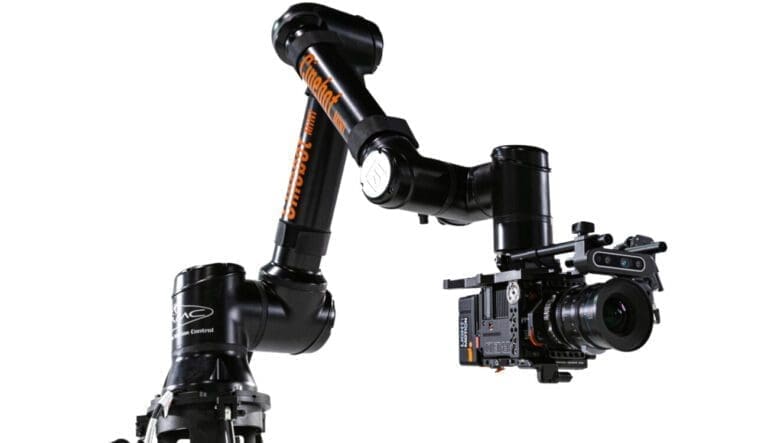
High-speed camera movement is what a robotic arm makes possible: a camera that accelerates from a standstill to several meters per second, whips around a subject, decelerates to a precise stop and does it again identically. The term is sometimes confused with high-speed cinematography, which means shooting at a high frame rate for slow motion. The two are often combined, with a fast-moving robot carrying a high-frame-rate camera, but they are different ideas. One is about how fast the camera moves; the other is about how many frames it captures.
The rigs that deliver it are industrial robots adapted for film, mounted on a base or a track, driven by software that defines the path and the speed. The result is a kind of movement audiences had never seen before these systems existed: a camera that behaves like an insect rather than a person.
Why it matters
Why high-speed camera movement matters
Speed creates energy. A camera that rushes toward a product and stops dead a hand's width from it delivers a jolt that no dolly can, and in a market where attention is measured in fractions of a second that jolt is valuable. The technique has become a signature of modern beverage, cosmetics and sports advertising for exactly that reason.
It also compresses time. A move that covers a whole set in two seconds lets a film show more in less, and when the move is paired with slow motion the contrast between the camera's speed and the subject's stillness becomes the shot.
In practice
How high-speed camera movement works in practice
- 01
The move is designed in software before the shoot, with the set and the product modeled so that the path, the lens and the timing are agreed in advance. The rig technician checks reach, velocity limits and clearances; an arm moving at full speed carries real force and the safety plan is not optional. Lighting is built for the path, with attention to flicker, because fast moves under the wrong lights strobe on camera.
- 02
On the day, the move is rehearsed at a fraction of its speed with stand-ins, then brought up gradually. Triggers for practical effects, such as a splash or a pour, are tied to the same timeline so that the event and the camera arrive together. The passes are logged with their programs and handed to post, where plates line up without manual matching.
Watch out
What people get wrong about high-speed camera movement
Chasing the move instead of the moment. A fast whip that ends on nothing in particular is an effect without a purpose, and audiences have seen enough of them to scroll past. The move should land on the thing the film is about. The other mistake is underestimating the physics. Lenses breathe, focus lags, lights flicker and mounts flex at speed, and a camera package chosen for a static product shot will not survive a fast one without testing.