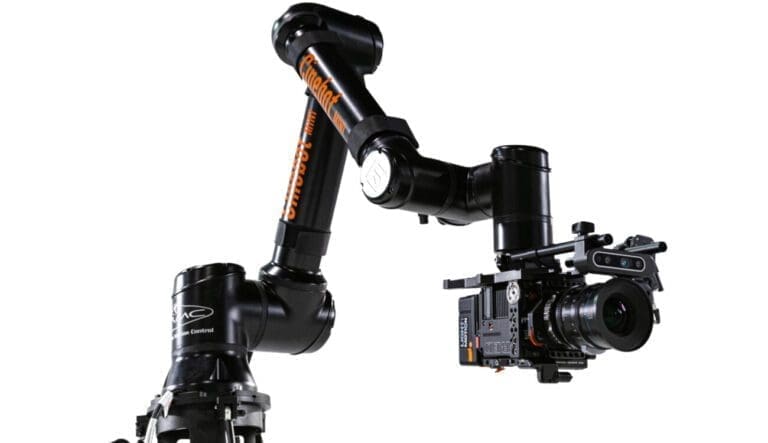
What is Hollywood motion control?
Hollywood motion control is the feature-film grade of the technology: the large, fast, precise rigs that were built to make visual effects possible and have since become standard on high-end commercial sets. The name is shorthand for a class of equipment rather than a brand. It covers the track-mounted robotic arms, the big motorized cranes and the software that drives them, all of it built to tolerances where a camera returns to the same point, frame after frame, to within a fraction of a millimeter.
The technology was born in the effects houses of the 1970s and 1980s, when a model spaceship, a star field and a planet had to be photographed on separate passes with identical camera moves so they could be combined. Digital compositing changed the workflow, but the need for repeatable moves never went away. It simply moved from spaceships to perfume bottles.
Why it matters
Why Hollywood motion control matters
The grade of the equipment decides what is possible. Lighter motion control systems can repeat a move slowly; the feature-film class can repeat it fast, with a heavy cinema camera, over a long path, and still match to the frame. That is what makes layered effects shots, high-speed product reveals and complex composite sequences achievable in a commercial schedule.
For a brand, it means the camera language of a studio film is available for a launch spot. The slow, inevitable push through a scene, the fast reveal that stops exactly on the product, the pass that stacks three elements into one impossible image: these come from this class of rig.
In practice
How Hollywood motion control works in practice
- 01
Everything is planned. The move is built in previsualization software with a model of the set, the product and the lens, and the sequence is agreed with the director and the cinematographer before the day. The rig arrives with its own technician and a safety protocol, because a full-size arm at speed is an industrial machine first and a camera support second.
- 02
On set the move is rehearsed at low speed, refined, then run at full speed for the real passes. Lighting is built for the path, triggers for effects are tied to the same timeline, and each pass is logged with its data so that post can composite without guesswork. A single shot can take a morning to build and a minute to shoot.
Watch out
What people get wrong about Hollywood motion control
Assuming the rig makes the shot. The rig executes a plan; the plan comes from a director and a cinematographer who know what the move is for. Productions that hire the equipment without the thinking get an expensive, very smooth, very empty move. The other mistake is treating it as the default. Most shots in most films do not need a robot, and the best use of this class of equipment is for the one or two shots in a campaign that genuinely cannot be made any other way.