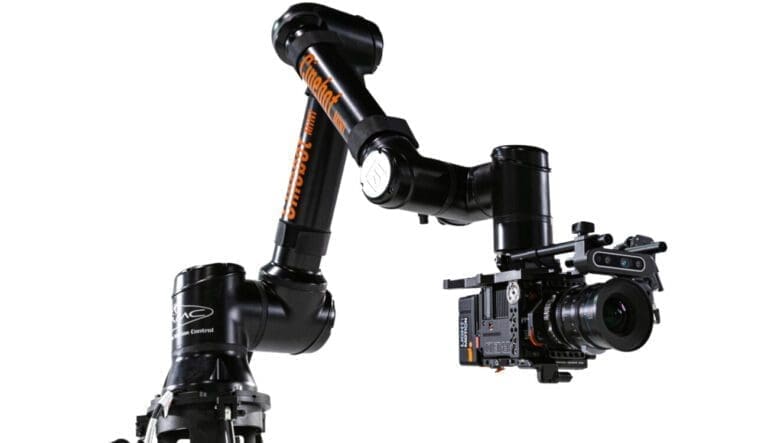
What is a programmable camera movement?
A programmable camera movement is a move that exists as data before it exists as footage. Instead of an operator pushing a dolly or panning a head by feel, the move is built in software: keyframes for position, speed curves between them, the timing of the start and the stop. The rig, whether a small motorized slider or a full robotic arm, reads that program and performs it, and it can perform it again a hundred times with no variation.
The idea scales. At the low end a programmable slider lets a solo shooter repeat a slow push for a product reveal. At the high end a six-axis robot flies a cinema camera through a choreographed path that no human could execute once, let alone twice.
Why it matters
Why programmable camera movements matter
Repeatability unlocks techniques that are otherwise impossible or impractical. Layered composites where several passes must align. Product variants shot with identical framing. Time-lapse with camera movement, where the rig advances a fraction of the move between each frame. Stop motion with a moving camera. Effects that are triggered on a specific frame of a specific move. None of these work reliably with a hand-operated camera.
The moves also look different. A programmed move has a smoothness and a deliberateness that audiences read as polish, and a stop that lands exactly on a product at exactly the right frame is a satisfying thing to watch. That look has become a signature of modern product advertising.
In practice
How a programmable camera movement works in practice
- 01
The move is designed first, in the rig's own software or in a previsualization tool, with the director and the cinematographer agreeing the framing at each key point and the speed between them. The move is loaded onto the rig and tested slowly on set, with adjustments to the keyframes until the frame is right. Lighting is built for the path.
- 02
Once approved, the move is run for each take, with the crew resetting the subject between passes. The program is saved with the take data, which means the move can be re-run later if a product variant needs the same shot, and post receives footage whose camera path is known to the frame.
Watch out
What people get wrong about programmable camera movements
Programming without a reason. A move that was built because the rig could do it rarely serves the story, and a pointless flourish is more visible when it is perfectly executed. The other mistake is under-planning the keyframes. A programmed move has no operator to correct it on the fly, so the framing at every point has to be right in the program, and a crew that tries to fix it on set is spending shoot time on prep.
A third is ignoring the speed curves. Two moves with the same start and end points can feel completely different depending on how they accelerate and settle, and the easing is where a programmed move stops looking mechanical and starts looking designed.