
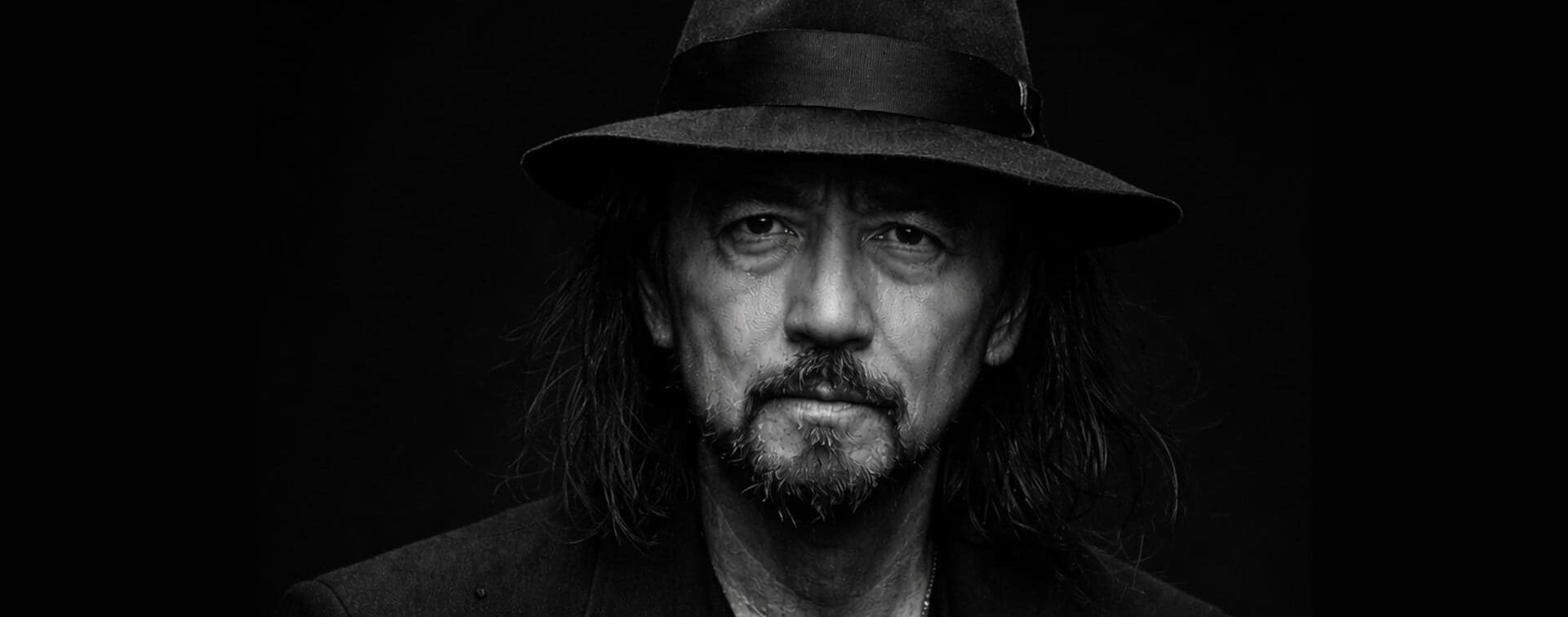
Yohji Yamamoto: The Poet in Black
This is not a quick read — it’s a long-form exploration of Yohji Yamamoto: philosopher of clothing, poet of restraint, and a creative force shaped by war, loss, and quiet resistance.
Over three chapters, we trace:
- His childhood in postwar Tokyo and the emotional origins of his work
- The shock of his Paris debut and the birth of so-called “anti-fashion”
- Black as a complete creative universe — architectural, cinematic, political
Expect archival runway footage, interviews, museum context, and Yohji’s own words — not as decoration, but as evidence.
Estimated time: 18–25 minutes
Recommended mindset: slow down. Don’t skim.
If you’re looking for trends, this isn’t it. If you’re interested in how creativity survives trauma — and how restraint becomes rebellion — you’re in the right place.
Chapter One: Shadow on the Crater
Tokyo, 1943. A city learning how to live with fire. Somewhere inside that fractured landscape, a boy is born into a world already in ruins. That boy will grow up to dress the ruins — to wrap the wound in wool, and let silence do the rest. To turn absence into elegance, and grief into a kind of armor.
Yohji Yamamoto arrives not into the glamour of fashion, but into its opposite: a burnt-out plain, a mother in mourning, and the lingering echo of a father who never comes home. Before he ever touches a pattern or cuts a silhouette, his first material is loss. His first classroom is the aftermath of war.
He will later be called many things — avant-garde icon, master of black, architect of anti-fashion — but beneath all those labels is something much simpler and more human: a man trying to protect people with clothing. A son trying to understand the shape of an absence.
The Burnt-Out Plain Called Home

Yohji Yamamoto receives applause at the conclusion of his Fall/Winter 2010 Y-3 show at New York Fashion Week, February 2010. Photo by Flickr user Masaki-H, via Wikimedia Commons. Licensed under Creative Commons Attribution-ShareAlike 2.0.
Yohji Yamamoto is born in Tokyo on October 3, 1943, in the final years of the Second World War, just as the city is becoming a crater of ash and twisted metal. His father is drafted and dies in the conflict, leaving his mother to raise him alone in what he would later describe as a “burnt-out plain” of a city — a landscape where survival itself is already an act of design.
His mother, Fumi, becomes a dressmaker to keep them both alive. Her sewing machine is not a symbol of glamour; it’s a survival engine. In that small atelier, Yohji watches women come and go, patterns layered across tables, fabric pinned and unpinned, hems adjusted, silhouettes negotiated. Clothing is not yet fantasy — it is negotiation, labor, compromise, adaptation.
Japan in the late 1940s and 1950s is a nation rebuilding itself from zero. Streets and identities are patched together. The country is trying to figure out how to be modern and proud while haunted by its own decisions. It’s no coincidence that a designer born into that tension will grow up obsessed with contradictions: modest and arrogant, fragile and strong, masculine and feminine, visible and invisible.
A Mother, a Needle, and the First Lessons in Protection
Yohji’s mother sews stories into people. She cuts and constructs garments for women who, like her, are navigating a world that does not particularly care if they are comfortable. Widows, workers, hostesses, women surviving on the edges of respectability — they all come through her shop. For a young Yohji, these women are the first models, the first muses, and the first evidence that clothing can be both shield and confession.
He learns to cut and sew by helping in that shop. At first it’s practical: he’s a son helping his mother. But the more he watches, the more he understands that clothing holds power. A hem can change a posture. A shoulder line can decide whether someone feels fragile or invincible. A coat can hide the truth or reveal it.
This is where the future poet in black learns his first language. Not the language of logos or trends, but the quiet mechanics of protection. Decades later, when he speaks about wanting to make clothes that act like armor for the body, he is really speaking about that cramped atelier in postwar Tokyo, that room where his mother worked herself to the bone so he could survive.
Law School and the Wrong Life
On paper, Yohji Yamamoto does the “right” thing first. He studies law. He enrolls at Keio University, one of Japan’s elite institutions, and graduates with a law degree in 1966. In another version of history, he becomes a lawyer, wears a suit someone else designed, and spends his life in offices instead of ateliers.
But cities and childhoods leave marks. That burnt-out Tokyo and that dressmaking mother are still there, sitting under the surface of his legal textbooks. The idea of defending people in a courtroom never feels as urgent as the idea of defending them with what they wear.
So, he walks away from the “sensible” path. He gives up the legal career waiting for him and returns to his mother’s shop to help her full time — cutting, stitching, fitting, absorbing. The decision feels less like a glamorous pivot and more like an act of duty. The son choosing the sewing machine over the briefcase is not chasing fame; he’s honoring the only person who ever truly protected him.
From there, the next step is inevitable: if clothing is going to be his life, he wants to do it with precision. He enrolls at Bunka Fashion College — one of Tokyo’s legendary fashion schools — and graduates in 1969, just a few years after names like Kenzo Takada walked the same corridors. In those classrooms he refines what he already knows instinctively from the shop: the cut, the fall, the weight, the way fabric moves when a person is tired, proud, scared, or in love.
Kabukichō Nights and the Shape of a Woman Walking Away

Kabukichō’s iconic red gate and neon-lit nightlife district in Shinjuku, Tokyo. Photo by Chensiyuan, via Wikimedia Commons. Licensed under CC BY-SA 4.0.
Much of Yohji’s early professional life unfolds in and around Shinjuku, specifically the Kabukichō district — Tokyo’s red-light heart. He has spoken about this area as “overflowing with women whose job was to titillate male customers.” For most people, this would be background. For Yohji, it becomes raw data.
He watches women walk the streets in too-tight dresses, squeezed into high heels, navigating neon, smoke, and male gaze. He sees the tension between what they seem to be selling and what they might wish to hide. He sees clothes as traps — corseted expectations, enforced seduction — and slowly, he begins to define what he does not want his own clothes to be.
Later, he will reject high heels as “ugly,” talk openly about his dislike of clothes that only exist to please men, and speaks often about wanting to dress women who “walk away from the world” rather than toward its judgment. In Kabukichō, he’s not just living in a neighborhood. He’s studying wounds.
This is why, when Yohji’s women appear on a runway years later, they are not showpieces. They dress like escape. They move in coats and layers that could survive a storm, hands buried in pockets, shoulders wrapped in volumes of black that swallow the male gaze instead of inviting it.
Why Black Arrives Before the Clothes
If you grow up under a widowed mother who wears sober colors because bright ones are considered inappropriate, black is not a “fashion statement.” It’s a code. In postwar Japan, black is mourning, discipline, modesty — a refusal to pretend everything is fine.
As Yohji begins to form his own design language, black naturally becomes the base note. Not because it’s chic, but because it’s honest. He will eventually crystallize this into one of his most famous lines:
“Black is modest and arrogant at the same time.”
— Yohji Yamamoto
Modest, because it doesn’t scream. Arrogant, because it refuses to explain itself.
In a world that wants bright colors and obvious luxury, Yohji chooses the “wrong” color and the “wrong” feeling: quiet resistance. His black does not ask for approval. It simply stands there and says, in its own language: I don’t bother you. Don’t bother me.
By the time Yohji Yamamoto is ready to take his work to Paris, the foundations are already set. The runway shows, the asymmetry, the so-called “anti-fashion” will all come later. But the crucial story is here, in this first chapter: a boy in a broken city, raised by a woman with a needle, learning that clothes can protect, that black can speak, and that sometimes the most radical thing a designer can do is to stand quietly in the corner and refuse to play along.
Chapter Two: When Paris Met the Black Earthquake
By the start of the 1980s, Paris thinks it knows what fashion is supposed to feel like. The body is the main event: shoulders armoured in power suits, waists cinched tight, color turned up to neon volume. Gloss, sex, success. Clothes that shout across a room.
And then, in April 1981, the lights go down. The soundtrack is not disco, not glossy pop, not the usual runway strut. It is a heartbeat — amplified, insistent, almost uncomfortable. Pale-faced models step into the darkness wearing oversized black shapes that seem less like garments and more like moving shadows, punctured with holes, dragging with strange, heavy grace.
Some editors lean forward, mesmerised. Others recoil. Within hours, headlines will call it a scandal. Within days, someone coins a phrase that will follow Yohji Yamamoto for years: “Hiroshima chic.” Casual cruelty dressed up as critique.
“Their 1981 Paris debut was met with hostility. Critics derided the collections as ‘Hiroshima chic,’ reacting to the designers’ use of black, asymmetry, and garments that refused to flatter the body. What was dismissed as bleak would later be recognized as revolutionary.”
— AnOther Magazine, “Perpetual Revolution: The Paradox of Yohji Yamamoto”
What they’re really reacting to is not a dress or a hemline. They’re reacting to the fact that, for the first time in a long time, fashion in Paris is making them feel afraid.
The Japanese Wave Crashes the Capital
Yohji does not arrive in Paris alone. He comes as part of a fault line.
In that same moment, another quiet revolutionary is stepping into the light: Rei Kawakubo of Comme des Garçons. She has already been showing in Tokyo for years, building an underground legend of ragged black, strange voids, and garments that look half-finished on purpose. Now, a Kawakubo and Yamamoto show side by side offered a double impact that critics will later call the birth of the “Japanese avant-garde.”
Together with Issey Miyake, who had already begun to shift Western perceptions of Japanese design, they form what the press will brand the Japanese Wave. To the European eye, trying to process this in real time, it looks like three designers crashing the party at once. To anyone paying attention, it’s something much bigger: a new way of thinking about the body, about gender, about beauty, about how clothes can exist in time and space.
“In 1981, when Rei Kawakubo and Yohji Yamamoto first presented their collections in Paris, their work—characterized by asymmetry, black garments, and a rejection of Western tailoring—came to be known as ‘Japan Shock,’ marking a fundamental shift in the history of contemporary fashion.”
— Kyoto Costume Institute (KCI), Digital Archives: 1980s – Japan Shock
Their silhouettes are loose, asymmetrical, abstract.
Their colors lean toward black, charcoal, shadow.
They tear at the idea that women must be exposed to be seen, or cinched to be powerful.
Instead of glossy perfection, they send out garments with frayed edges and awkward gaps, clothes that look like they’ve survived something. Paris, which has spent decades treating itself as the unquestioned centre of beauty, suddenly finds itself on the receiving end of a critique it didn’t ask for.
The Heartbeat Show
The 1981 debut is not just a collection; it’s a staged confrontation.
The story goes like this: Yohji decides there will be no music, no easy mood-setting, no distractions. Just the amplified sound of a human heartbeat thudding through the space. Each model appears in layered black — coats that swallow the body, knits with irregular holes, skirts that fall in uneven planes. Faces are pale, almost ghostlike, hair unstyled, expressions flat. No one is trying to seduce you. No one is smiling for the buyers.
In a decade fuelled by pop excess, this is closer to performance art. The audience is being forced to sit inside someone else’s pulse, someone else’s fear, someone else’s memory of postwar Japan. All those images from Yohji’s childhood now walk the runway disguised as coats and dresses.
It is, in every sense, an anti-show. Which is why so many people can’t stop talking about it.
“Hiroshima Chic” and the Violence of Misunderstanding
The backlash is swift and vicious. French critics, bewildered by the absence of color and the refusal to flatter the female form, reach for the nearest insult they can find. One newspaper dubs the look “Hiroshima chic,” a phrase that will echo like shrapnel through Yamamoto’s career. The term is revealing. It shows how little the critics understand the work — and how lightly they treat a trauma that shaped Yohji’s whole life. To him, black is not a costume of destruction; it is a way of acknowledging that destruction happened, and that life had to grow in the crater anyway.
Others call the clothes “ragged,” “mournful,” “aggressively ugly.” They accuse Yamamoto and Kawakubo of attacking the idea of beauty itself, of bringing ruin to Parisian elegance. Some see it as an act of cultural rudeness — these designers from Tokyo, daring to rewrite the rules in fashion’s capital city.
“I think perfection is ugly. Somewhere in the things humans make, I want to see scars, failure, disorder, distortion.”
— Yohji Yamamoto
But in the same rows, there are editors, students, and young designers whose hearts are pounding with a different emotion: recognition. They see, clearly, that something seismic is happening. Here are clothes that don’t obey the male gaze, that don’t bow to the bodycon fantasy of the decade, that don’t pretend life is neat and glittering.
For them, this is not “Hiroshima chic.” It’s liberation.
Anti-Fashion, or Fashion Turned Inside Out
In the months and years that follow, critics will search for language big enough to hold what Yohji and Rei have done. The phrase that sticks is anti-fashion: a movement that seems to move against everything fashion is supposed to be. But look closer and you realize they’re not against fashion at all; they’re against laziness. Against automatic assumptions about what a dress must do, how a woman must look, how a garment must cling.
Yohji never believed originality came from isolation. He believed it came from obsession.
“Copy, copy, copy, copy. At the end of the copy you will find yourself.”
— Yohji Yamamoto
Yohji’s shapes refuse the standard architecture of Western tailoring. Instead of sculpting the body into a statue, he lets the cloth fall like smoke, or hang like a secret. He hides the waist instead of emphasising it. He collapses gender codes, putting men in soft layers and women in coats that feel almost martial. If 1980s Paris fashion is about showing everything — status, sex, money, muscle — Yohji’s collections are about the right to show nothing. To walk through the world in a kind of portable privacy.
“Yamamoto’s early work challenged Western notions of tailoring by obscuring the body in unstructured layers, redefining the relationship between garment and form.”
— The Metropolitan Museum of Art,
Collection Entry: Yohji Yamamoto
In earlier years, he had watched the hostesses and sex workers of Kabukichō selling a version of themselves for survival. Now, in Paris, he offers a counter-image: women in boots, in heavy coats, in clothes that look capable of surviving an argument with the universe. It’s no wonder that some see these looks as hostile. They are hostile — not to the women wearing them, but to the structures that demand their compliance.
Rei and Yohji: Parallel Lines in the Same Earthquake
From the outside, journalists like to frame Rei Kawakubo and Yohji Yamamoto as a matched set: the king and queen of black, two sides of the same dystopian coin. They’re bundled together under headlines about “Japan Shock” and “the black crows of fashion.” In reality, their work moves in parallel, not in unison.
Rei’s garments often feel like conceptual puzzles — lace slashed apart, padding where it shouldn’t be, holes that look like missing memories. Yohji’s clothes are more like sentences you could actually live inside: coats, trousers, long skirts. If Rei attacks the idea of beauty, Yohji mourns it. If her runway feels like a thesis on the body, his feels like a long, sad jazz track played in the dark.
Yet the two are united by refusal.
Refusal to accept that women must be decorative.
Refusal to make “flattering” the highest goal of a garment.
Refusal to separate intellect from fabric.
In their shared Paris debut, they don’t just put Japan on the fashion map; they redraw the entire map so that East and West are no longer simple opposites, but entangled forces. After 1981, it becomes impossible to talk about contemporary fashion without talking about them.
Shock, Then Echo
At first, buyers are cautious. Some stores refuse to take the collections at all; others bury them in dark corners, unsure which customers might wear such confrontational quietness. But the echo builds. Students copy the silhouettes in cheaper fabrics. Other designers begin to loosen their lines, bleach their colors, let imperfection creep into their work.
Within a few seasons, what was once a scandal starts to look like the future. Deconstruction, asymmetry, and androgyny — all the things that were spat at in review columns — seep into the mainstream and lose their scare quotes. By the 1990s, fashion will congratulate itself on being “edgy,” forgetting that it once booed the people who made that edge possible.
For Yohji, the memory of that first reception never quite leaves.
He carries the insult and the applause together, like two pockets full of stones.
In interviews, he will often say he doesn’t care what critics think, and in many ways that’s true. But he also understands that their violence revealed something important: how fragile Western beauty standards really were.
From Runway Quake to Creative Blueprint
Seen from the vantage point of now, the 1981 show is more than a fashion moment.
It’s a blueprint for a particular kind of creative disruption — the kind RIOT lives for.
Take a system that believes itself untouchable.
Strip away its soundtrack, its glamour, its illusions.
Insert a new language — one born from a different history.
Accept that the first reaction will be defensive, even cruel.
Stand your ground anyway.
That is what Yohji did in Paris.
He didn’t just bring black clothes; he brought his burnt-out Tokyo, his widowed mother, his Kabukichō nights, his anger at how women are forced to perform. He poured all of it into a collection and let the heartbeat speak.
The aftershock is still being measured in the way we dress today: in every oversized coat, every asymmetrical hem, every designer who dares to choose restraint over spectacle.
And for Yohji Yamamoto, the Poet in Black, it was only the opening stanza.
Chapter Three: The Color Black as a Universe
Before Yohji Yamamoto ever cuts a pattern, before he ever sends a model down a runway, before Paris even knows his name, one element of his creative language is already decided.
It is not a fabric, not a silhouette, not a technique.
It is a color — or more accurately, the gravitational field of a color.
Black.
For Yohji, black is not absence. Black is biography. Black is inheritance. Black is rebellion disguised as modesty.
Black is the place where memory lives.
And long before the fashion world attaches words like “avant-garde” or “anti-fashion” to his work, he already understands something deeper: black is the closest color to truth.
Black as Biography
Postwar Tokyo teaches Yohji that color can be a kind of betrayal. Bright hues imply celebration, and celebration feels dishonest in a city rebuilding itself from ash. His mother, widowed by war, dresses in sober tones — a quiet code of grief and dignity. Her presence becomes the template: the silhouette of strength without spectacle.
When Yohji chooses black, he is not choosing fashion. He is choosing her. He is choosing the memory of women who survived by working, sewing, navigating a world that rarely protected them. Black becomes the uniform of those who do not have the time or luxury to perform happiness.
And so, as his collections evolve, black becomes the emotional foundation — a color that remembers things the world tries to forget.
Black as Philosophy
Yohji’s infamous line is deceptively simple:
“Black is modest and arrogant at the same time.”
This is how he sees the world. Modesty without apology. Arrogance without noise. Black resists interpretation. It refuses the demand to entertain. It carries itself with a confidence that does not need to announce itself. To Yohji, bright colors feel like lies — too eager, too obvious, too determined to please the eye.
Black, on the other hand, is honest.
It does not pretend to be anything but what it is. It does not seek validation. It simply exists — quietly, powerfully, with the full weight of its own integrity.
Black as Architecture
Architects talk about space as the void that gives shape to form. Yohji treats black the same way. In his hands, black becomes architecture — a structure built out of emptiness, silhouette, and shadow.
“Just listen to the material. What is it going to say? Just wait.”
— Yohji Yamamoto
Some colors sit on the surface of fabric. Black sinks into it. It turns the garment into a topography, where folds and planes become landscapes. Volume becomes more dramatic. Asymmetry becomes more mysterious. An oversized coat in black becomes a piece of moving architecture: a building that walks.
Photographers often say that black is the hardest color to shoot, because it swallows light. But the ones who understand Yohji’s work know the secret — black creates its own light. It glows differently. It absorbs reflection like memory absorbs time.
Black as Cinematic Language
There is a reason Yohji’s collections feel like cinema. Black is the color of every frame that matters: film noir shadows, backstage corridors, vinyl records spinning at 2 a.m., jazz clubs where heartbreak becomes melody.
“Fashion is not decoration. It is a reflection of how we move through cities, how we inhabit space, and how we exist in the world.”
— Notebook on Cities and Clothes (1989), directed by Wim Wenders
When his models move, black exaggerates the softness or sharpness of each gesture. Fabrics drift like smoke or cut the air like blades. The runway becomes a kind of slow-motion drama, where the plot is the movement of cloth through shadow.
In Yohji’s world, black is not flat. It is atmospheric — a weather system made of darkness.
Black as Feminist Armor
Yohji’s relationship with women is not rooted in fantasy; it is rooted in protection. He often speaks about wanting to make clothes that defend the wearer — garments that give a woman space, dignity, and autonomy.
“I want to make clothes that protect women, not clothes that expose them.”
— Yohji Yamamoto
Black becomes a shield.
It hides what the world demands to see.
It creates privacy in a culture obsessed with exposure. And because black can be both soft and severe, it allows a woman to choose her own presence — to be invisible or unmistakable.
His silhouettes reject the idea that beauty requires obedience. Black becomes the armor of independence.
Black as Quiet Punk
Where Western rebellion shouts, Yohji’s rebellion whispers. He does not tear fabric apart to shock. He does not use color to provoke. His version of punk is stillness — a refusal to participate in the noise.
Black is the perfect medium for this kind of protest.
It signals rebellion without spectacle.
It communicates dissent without performance.
It is a middle finger delivered with absolute calm.
This idea predates and influences entire creative lineages: Rick Owens’ brutalist glamour, Ann Demeulemeester’s poetic shadows, the Antwerp Six’s lean into monochrome cool. Yohji gave them all permission to be quiet and dangerous at the same time.
Black in Yohji’s Major Collections
From the early “ragged black” of the 1980s to the sculptural experiments of the 1990s, black never stops evolving in Yohji’s hands.
Sometimes it is soft, almost melancholic. Sometimes it is rigid, architectural, held together by buckles or wooden slats.
Sometimes it becomes athletic futurism, especially as Y-3 brings his philosophy into the world of sport.
Black becomes the thread binding all these eras together — not consistency for its own sake, but the same way a poet returns to a favorite metaphor because it still has more to say.
The Universal Black
Yohji often says that everyone looks beautiful in black. Not because black hides the body, but because black reveals the real body — the movement, the posture, the presence.
Black democratizes.
It frees the wearer from trend cycles.
It gives dignity to every kind of silhouette.
It equalizes without flattening identity.
In menswear, black becomes a study of structure and ease.
In womenswear, black becomes a negotiation between strength and vulnerability.
But in both cases, black is the constant: the material of truth.
The Poet in Black
In the end, Yohji’s universe is built from this single color not out of limitation, but out of devotion. Black is the lens through which he sees the world, the atmosphere of his childhood, the echo of his mother, the shape of his philosophy.
Black is the color of honesty, of rebellion, of protection.
Black refuses performance.
Black shelters the wearer from the world’s demands.
And in Yohji’s hands, black becomes more than a color. It becomes a language — one spoken softly, one that must be listened to with care, one that reveals its meaning through depth.
To understand Yohji Yamamoto, you must understand black.
Because for him, black is not the absence of light.
It is the beginning of everything.